

The lake health assessment of Lake Massawippi is a sampling program carried out each year in June, July, and August. It allows for tracking changes in water quality by measuring various physico-chemical parameters. The data collected serve as a reference for decision-makers, environmental managers, and local communities to help preserve the health of the lake for future generations.
Lake health assessment: monitoring the state of the lake over time

To draw reliable conclusions and establish trends, it is important to measure several parameters, such as the following:
Water transparency: the ability of water to transmit light, also referred to as turbidity. High transparency indicates clear water.
Total phosphorus: an essential nutrient for living organisms, often limiting in aquatic environments. The addition of this nutrient to a water body can have significant environmental consequences, notably by promoting excessive growth of aquatic plants and contributing to eutrophication.
Nitrites and nitrates: nitrogen, found in nitrites and nitrates, is an essential nutrient for plants and algae. It occurs naturally in the environment, but anthropogenic inputs, such as agricultural fertilizers, increase nitrogen concentrations and promote eutrophication.
Chlorophyll a: chlorophyll is a green pigment found in photosynthetic organisms such as phytoplankton. It exists in different forms, including chlorophyll a, the common pigment in most algae. Therefore, chlorophyll a concentration is a good indicator of phytoplankton biomass and is often associated with phosphorus concentration.
Dissolved organic carbon: it comes from the decomposition of living organisms. Its concentration allows the assessment of substances responsible for water coloration. An increase in dissolved organic carbon leads to a decrease in water transparency.
pH: to support aquatic life, pH should be between 6.5 and 9. Many biogeochemical processes are strongly influenced by significant pH variations.
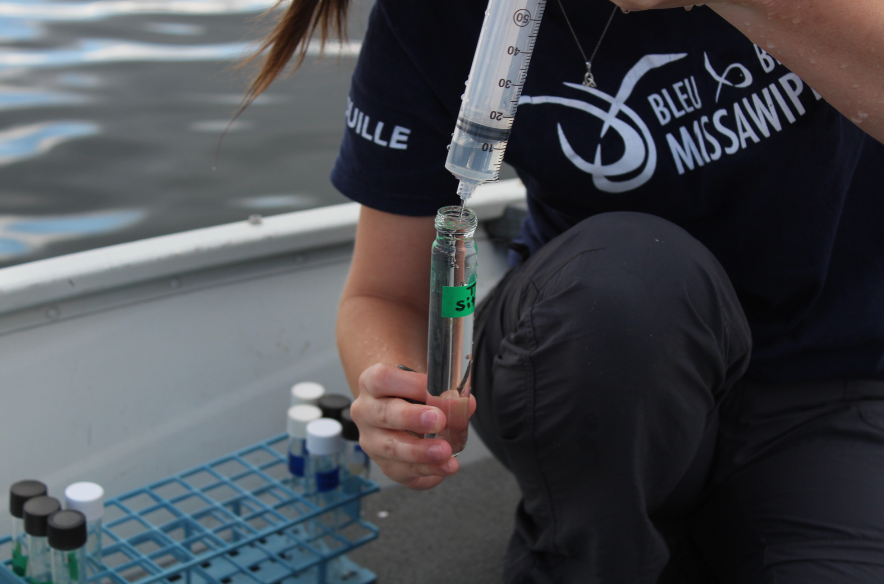
The five-year study from 2020 to 2024 revealed a slight decline in water quality in Lake Massawippi, although it overall maintains an acceptable trophic status, generally ranging from oligomesotrophic to mesotrophic. Notable interannual variations were observed, highlighting the importance of continuous monitoring to detect potential long-term changes.